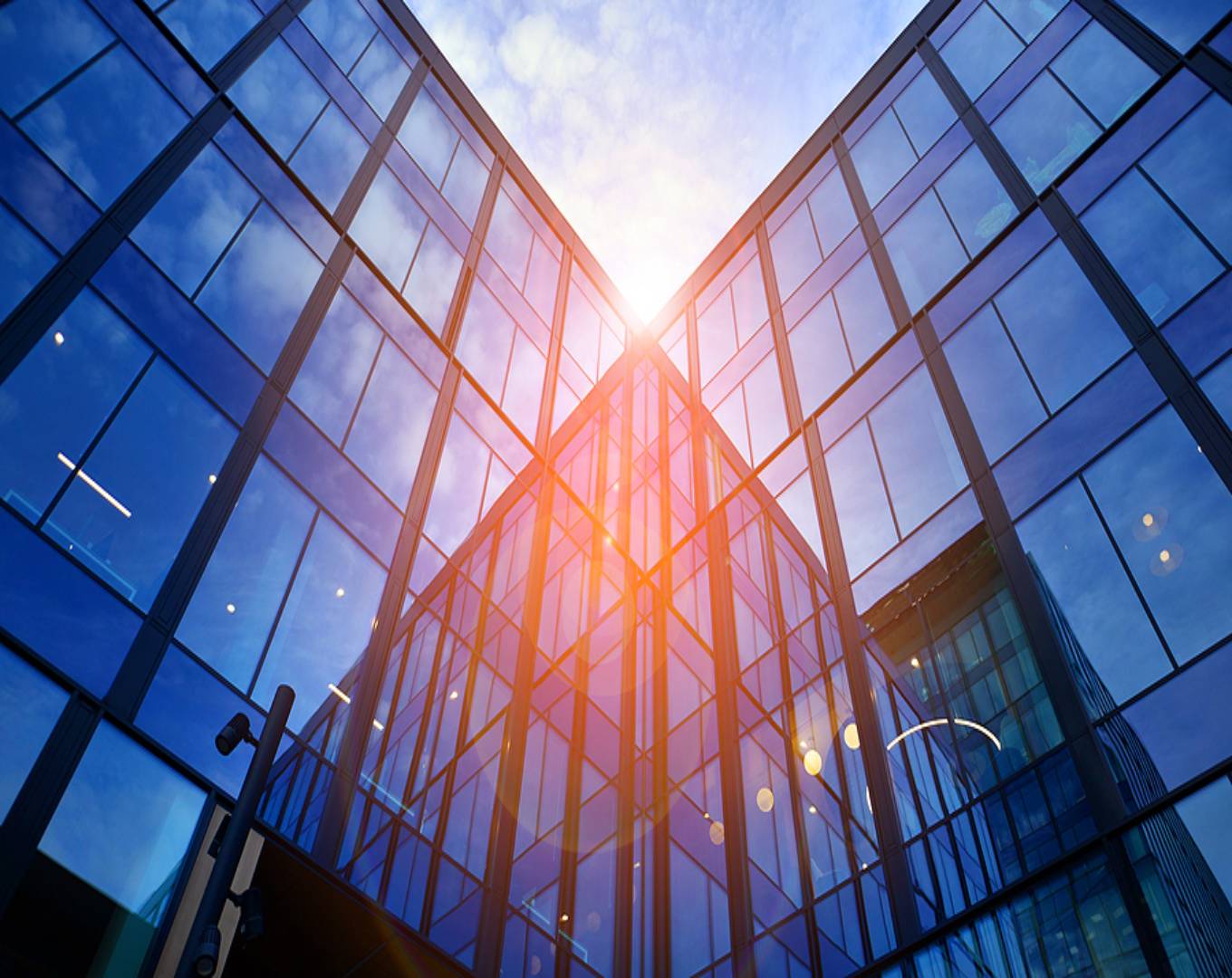
The value of glass in a building is often underestimated. Windows may be a standard feature taken for granted, but often its use elsewhere, such as in balustrades, doors and staircases, is seen as simply a stylistic design element, a matter on which one can be indifferent unless deeply interested in architecture and interior design trends.
However, to think this way would be to ignore the key benefits of glass. The first and most obvious is light and visibility, coming not just through windows but through internal glass structures that improve visual recognition, provide more natural illumination and give what might otherwise be daunting and enclosed spaces a feeling of openness.
This is certainly important in large public buildings where people can benefit from being able to see where they need to go, but the benefits of glass can literally start at the door.
The Value Of Glass Doors In Big Buildings
Having a large glass door in any building can help make the entrance look particularly welcoming. It is not just visually impressive; it provides immediate visual evidence of the internal environment that lies beyond. It confirms this is not something subconsciously mysterious, dark or full of uncertainty. Instead, it is light, open and revealing.
That can be particularly useful in a building that might feel like a daunting place to enter, such as a school, an office or a place of worship. Those coming to such a building might wonder what lies beyond, so being able to see inside can be very reassuring.
A railway station might not quite fit in such a category. After all, people usually come to the station not for work or to carry out social activity at the location, but to start a journey or meet someone who has just got off a train at the end of their trip.
However, there can be ways in which a railway station is daunting. One is if it is night-time and the passenger has a fear of being a victim of crime, in which case a lot of visibility and a lack of shadows in which miscreants might lurk is a welcome thing. The other is the sheer size and unfamiliarity of a large station to anyone visiting it for the first time.
Birmingham’s Grand Plans
An upcoming example of this will be found in Birmingham. The city has already made its mark on modern station design in recent years with a massive revamp of New Street Station. Now the HS2 terminus at Curzon Street and the Interchange Station just outside the city in Solihull will be next.
An almost total rebuild of the former station at the site on the eastern edge of the city centre (bar a couple of small but grand old buildings that were part of the old entrance) includes a large glass frontage, with the wide glass doors forming part of this to offer the most airy, naturally illuminated vista anyone entering a large railway terminus could possibly imagine.
Work is now underway on the station building, with the impressive glass frontage to be built in 2025.
At the Interchange Station, located close to Birmingham Airport, glass doors are again an obvious feature of what HS2 has described as “one of the world’s most environmentally friendly stations”.
Once more, lots of glass and light materials, with no pillars obstructing the views, means there is lots of light and space and finding the right platform will consequently be much easier.
Lots Of Glass At Old Oak
At the London end of the line, work at Euston will mean adding to the existing station, but to the north-west, Old Oak Common is getting a grand new station that will interchange with Crossrail as well as other mainline and Tube services.
Work will soon begin on this as the new partner to deliver mechanical, electrical, public health, fire and communications systems has just been named as French firm Egis. It will play a key role in delivering another state-of-the art station with modern design features and outstanding environmental performance.
A glance at the design and the descriptions given of it reveal that glass doors will once again be the way in to a “light and airy concourse”.
Of course, it is not just new stations on the HS2 system that will be built this way. This is just as well, because the system has suffered a major reputational blow before it has even started due to the soaring cost of the project, which has led in turn to the cancellation of first the north-eastern leg and then, last year, the north-western section.
This means that for all the great design features at Curzon Street, Interchange and Old Oak Common, they will not be replicated in Sheffield, Leeds or Manchester.
Alternative Northern Projects
However, even as prime minster Rishi Sunak announced the curtailing of the project in his 2023 Conservative Party conference speech – ironically at a former railway station in Manchester – he revealed plans for a major new station for Bradford. Could this be designed with similarly fine glass elements?
There is no doubt Bradford needs such a station. It currently has two very small city centre stations, a poor provision for its population of over 550,000 that pales by comparison with the 16-platform hub in next door Leeds. The stations are not connected and the city as a whole is poorly linked to the rest of the north, let alone the country at large.
However, the new station may be part of a revamp of the proposed east-west ‘Northern Powerhouse Rail’ that could link Bradford and Leeds with Liverpool and Manchester to the west and Hull to the east.
That might also involve much station-building work in Manchester after all. There may not be an HS2 hub at Piccadilly, but the east-west link, seen as so vital to ‘levelling up’ efforts for the north, has been the subject of much debate, not least whether any new interchange at Piccadilly should be overground or underground.
Whatever new station projects do take place in the coming years, what is not in doubt is that the attractive entrances provided by glass doors in modern stations offer a design feature that, unlike cash-conscious politicians worried about the bill for HS2, nobody will be abandoning.