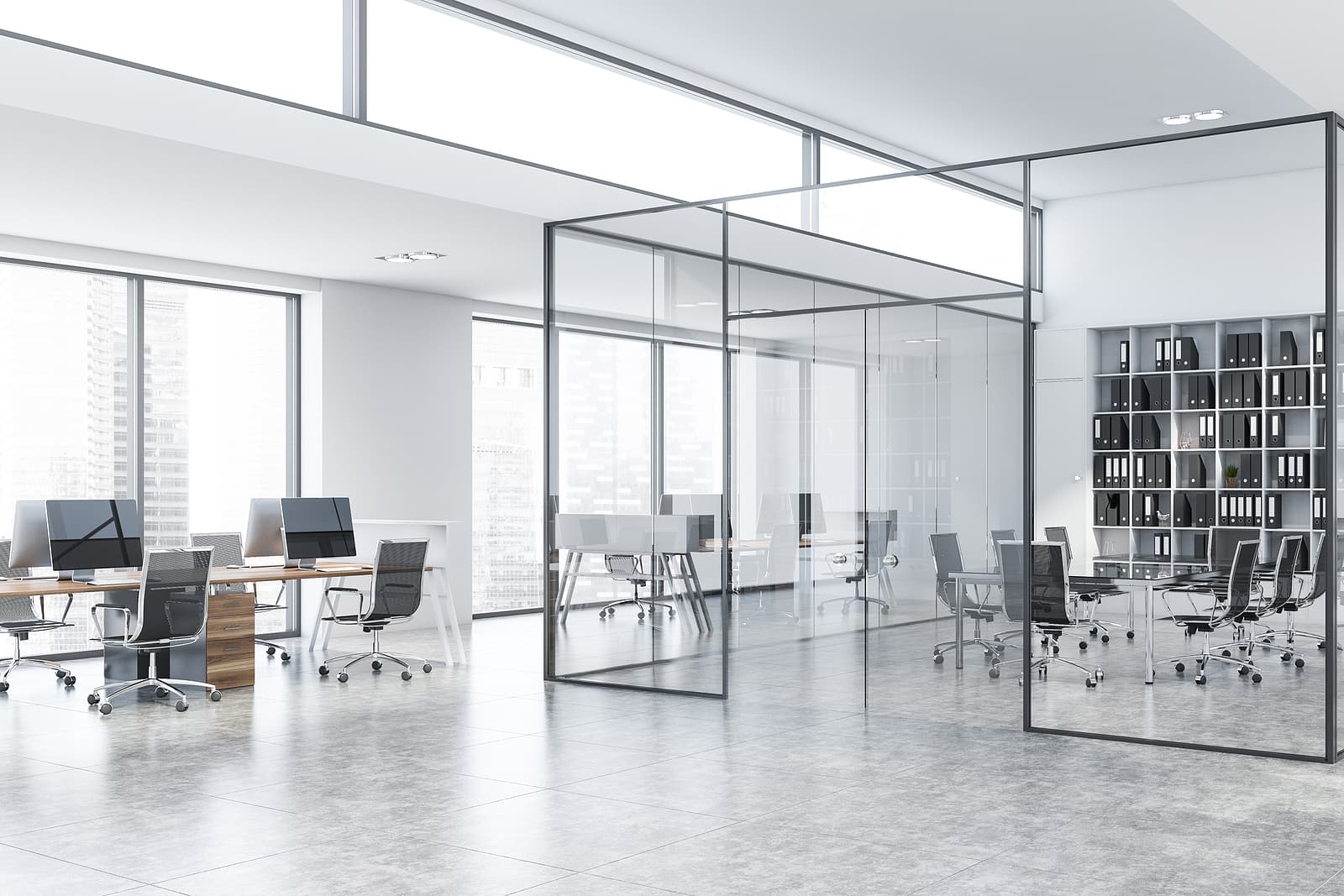
Arguably the most important element of the interior and exterior designs of our urban landscapes is strengthened glass tough enough to be used as a structural element.
From solid partitions in office complexes, curtain walls for skyscrapers and inventive and beautiful staircases in modern homes, the contribution of increasingly sophisticated and strong glass cannot be understated.
The development of toughened glass from the late 19th century to the present day has helped shape the architectural world as we know it, but the key principles that have made ever-stronger glass possible started with a party trick that rose to prominence in the 17th century.
The Tears Of Prince Rupert
A Prince Rupert’s Drop, also known as a Batavian tear, is a bead of glass infamous for being one of the strongest and weakest pieces of glass ever made, depending on which part you touch.
Resembling glass tadpoles, the bulbous part is so strong that it can shatter bullets, but any slight damage to the long, thin glass tail and it immediately shatters in explosive fashion.
They were made when molten glass droplets fell into cold water in a process known as
quenching. It can happen in nature when small drops of lava cool rapidly, which in this context is known as Pele’s tears.
Whilst there are suggestions that glassmakers knew about these unique droplets as far back as the Roman Empire, the name itself comes from Prince Rupert of the Rhine, an English-German scientist and military officer otherwise best known as the commander of the Royalist Cavaliers during the English Civil War.
When the monarchy was restored in 1660 and Prince Rupert returned, he brought with him a rather unusual gift for the newly appointed King Charles II, and the intrigued king sent them in turn to the Royal Society to be studied intently.
There is some evidence that the concept was known in North Germany as far back as 1625, and prior to 1660, it had already become a topic of discussion across Europe.
Author and philosopher Margeret Cavendish and Dutch composer Constantijn Huygens discussed the drops at length in a series of letters in March 1657, but the Royal Society’s experimentation was where the concept started to fascinate the intelligentsia of 17th-century England.
Outside of the experiments in the Royal Society, the drops began to spread across the upper classes and became increasingly used as a party piece, with demonstrations of how one side would withstand hefty blows from a hammer yet a light touch of the tail could make it explode immediately being a point of pure fascination.
However, none of the esteemed scientists or philosophers would come close to the answer of why Prince Rupert’s drops had these contradictory qualities, and it would take until the invention of high-speed cameras that could slow down the process to one that the human mind could comprehend for anyone to come close.
This is part of the reason why they endured in popularity despite lacking any practical purpose; unlocking the secret of why it was so strong would allow for the creation of a see-through substance that was stronger than plate armour.
The sheer gulf of knowledge allowed for some fascinating theories; Margaret Cavendish believed the properties were due to a pocket of volatile liquid,
The closest possible theory given the information of the era was posited by Robert Hooke in the book Micrographia, as a combination of elasticity properties (although it would take 400 years to quantify this) and that cracks can cause brittle materials to fail.
However, whilst it would take until 2017 for the properties of Prince Rupert’s drops to be fully explained, the toughened glass produced by the stresses of quenching molten glass started to produce results as early as 1874.
This was when Francois Royer de la Bastie developed a process of quenching glass in grease that created a practical form of tempered glass that would later become known as Bastie glass.
In a moment of parallel thinking, Friedrich Siemens of Germany developed another process that created even stronger tempered glass by pressing glass into cool moulds.
It would take until the 20th century and the work of Rudolph Seiden for the first patent on a full procedure for tempering glass to be produced.
All of these developments would come decades before Srinivasan Chandrasekar and Munawar Chaudhri’s 1994 landmark study using high-speed cameras that finally started to explain why the world’s first toughened glass behaved the way it did.
To this day, Prince Rupert’s drops continue to fascinate, and later revelations about why they possess the strengthened qualities they do have contributed to the development of even stronger types of glass than ever before.