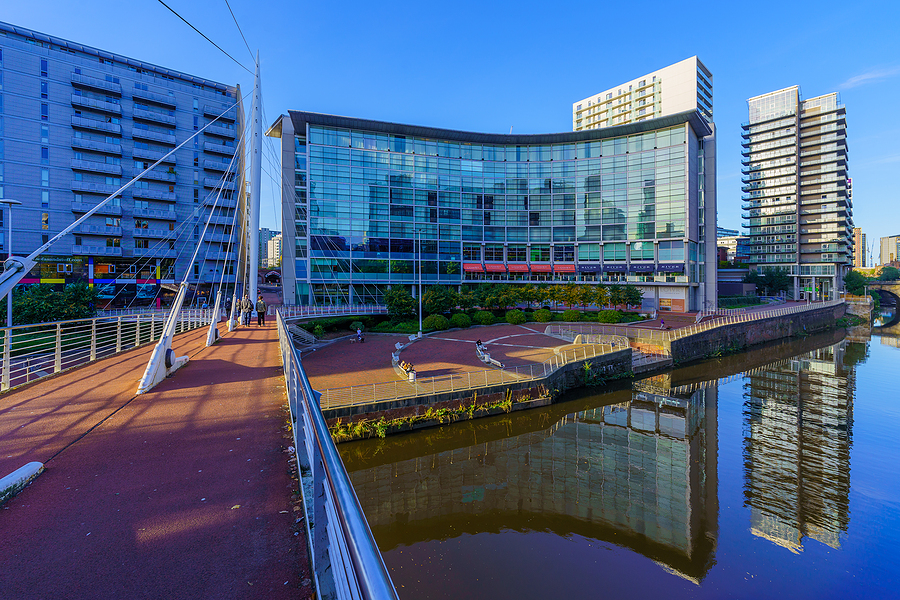
The modern office is one that prioritises the diffusion of as much natural light as possible whilst minimising glare, typically through the use of large windows, glazed partitions and structural glass.
The reasons for this are both practical and aesthetic. From a practical standpoint, natural light helps with eye health, mental health, and levels of vitamin D, and all of these aspects help boost productivity.
From an aesthetic standpoint, greater levels of natural light allow for more versatile interior design, particularly if a business is aiming for a professional, minimalist look reliant on brushed steel, glass and natural textures such as wood or polished stone.
Many people who work in high-rise city offices will recognise this type of open-plan office with that type of interior design, but whilst its first major use was in the UN Secretariat Building which made glass curtain facades the de facto standard for architecture, another skyscraper created that standard.
To understand how it happened, why skyscrapers and glassworking evolved together the way they did and why it took so long for the standard to become the standard, we need to look at two buildings in Liverpool and the impact they had on a young American studying in Merseyside.
Birthplace Of The Glass Curtain
The very first building to be built to take advantage of the bright open spaces only possible through the prominent use of glazing is Oriel Chambers, a Grade I listed office constructed in 1864.
Two years later it was joined by 16 Cook Street, a Grade II* listed office that took the concept significantly further.
The two buildings were designed by Peter Ellis, a civil engineer, inventor and architect who was so far ahead of his time with both buildings that they were subject to some absolutely brutal criticism.
Possibly the harshest criticism came from The Builder, who described Oriel Chambers as uglier than the “plainest brick warehouse” on Liverpool’s docklands, and claimed that the design was inspired by the large shop windows of a pawnbroker.
Modern reviews on the other hand are filled with nothing but effluent praise for his remarkable foresight, as well as the use of a glass spiral staircase that is far more reminiscent of a sleek modern office than the types of classical-inspired designs popular in the Victorian age.
Peter Ellis did not quit architecture, but prioritised the other parts of his work, allegedly as a response to the critical reception. However, a teenage boy who had left Atlanta, Georgia in the midst of the American Civil War was paying close attention.
Prelude To The Future
Born in the city of Lumpkin, John Wellborn Root was raised in Atlanta, but by the age of 14 had been shipped off on a steamship to escape the march of the Union Army after it fell from the clutches of the Confederacy in what became the turning point of American history.
Young Mr Root would have been a teenager as the two buildings were constructed, and whilst it was never entirely confirmed, these two pioneering structures appeared to have a strong impact on his own work when he became an architect in Chicago, Illinois.
Many of his early developments did not show this inspiration, mostly focused on developing technologies to ensure that large buildings could be constructed on the soft Illinois soil, a process known as the floating raft system.
This helped his budding architecture firm, Burnham & Root, to build an exceptionally strong reputation, and working with building owner William Ellery Hale, it was agreed by both parties that the big priority for the building was going to be natural lighting.
This became popular thanks to a loose development of architectural ideas often described retroactively as the Chicago school, although a lot of early designers later characterised as such tended to be described at the time as “Commercial Style”.
These buildings used the now conventional system for large-scale buildings of designing a steel frame with a cladding typically made of terracotta brick and glass, housed on a reinforced concrete foundation often known as the floating raft system.
This not only allowed buildings at this scale to be constructed at all but also allowed for much more versatile buildings that followed the architectural philosophy of form following function.
This meant that buildings would not sacrifice their functionality for the sake of extra ornamentation, and whilst they were hardly the minimalist structures that are familiar to architects and office workers today, they are notable for prioritising glass curtains and the light they bring over other design functions.
The Reliance Building was John Root’s last project, and he was exceptionally keen to prioritise natural lighting, designing the basement and first floor around this design concept. As well as this, the enamelled terracotta was believed to make the building self-cleaning, although this turned out not to be the case.
Unfortunately, whilst the lower floors were being completed, John Root tragically died of pneumonia at the age of just 41 in 1891. The plans for the rest of the building were never found.
Ultimately, Charles Atwood completed the design based on similar principles of practicality and letting in considerable amounts of light into the retail and office spaces, with the name “Reliance” coming from its functionality even compared to other Burnham & Root designs.
Its legacy is as a turning point in architectural history; whilst the building itself ended up in significant trouble by the 1930s as it was not terribly suited to modern retail needs, it both inspired and was inspired by the European Modernist movement.
Both architectural schools would evolve in parallel as the skyscraper became one of the dominant architectural achievements of the 20th century, ultimately culminating in buildings such as the Secretariat Building in New York and the legions of buildings that it directly inspired.
However, architecture is about evolution, and the Reliance Building was the turning point where the modern building design world began, with a major external architectural revolution reflecting on interior design concepts as well as an increased growth in the use of structural glass.