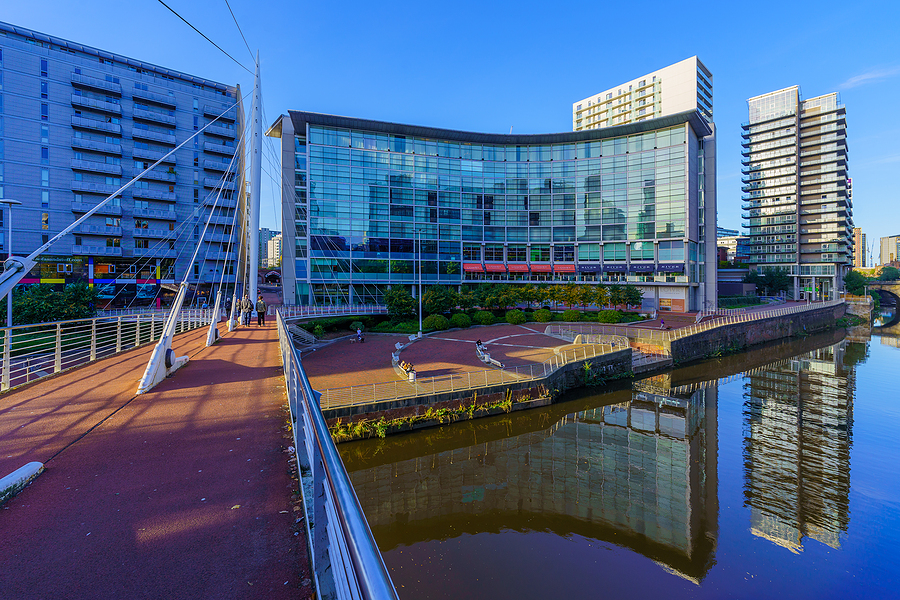
The UK used to be a country with very few particularly tall buildings, looking at cities like New York or Chicago as novelties without any thought Britain would emulate them. Much has changed.
Now, the 1,000 ft skyscraper is a reality, with the 1,016 ft (310 m) Shard towering over London, while several other buildings are not far short of it in height. Plans were recently published to break the record for the tallest London tower with an even higher building, although the proposed One Undershaft will exceed the Shard by just a few centimetres.
Most of Britain’s tallest buildings are located in London, but the recent surge in skyscraper construction can be seen in other cities.
Reaching For The Sky
Manchester has been particularly busy and, having seen the record for the city’s tallest building already broken twice in the last 18 years, it may see it shattered twice more in this decade with ever-taller buildings on the way. These will be re-writing records by many feet, not a few inches.
The same trends can be seen to lesser extents in other big cities like Birmingham, Liverpool and Leeds, while even smaller locations like Swansea, Brighton & Hove, Portsmouth and Woking all now have towers over 100 metres in height. Outside London, these are almost all residential apartment buildings.
A Towering Inferno?
While this is transforming skylines across the UK, not everyone is a fan. Some have aesthetic or traditionalist reasons for this, but some might pose questions about matters such as fire safety. This could be most obviously asked in London, where the Grenfell fire disaster of 2017 sticks in the memory.
While issues of fire safety regulations, inadequate cladding, the lack of sprinklers and the response to the emergency of the London Fire Brigade were all major topics covered by the enquiry, the suspicion may linger among some that building high is itself a fire safety risk.
However, that may be countered by the understanding that the materials used in a building can make a huge difference. This does not just apply to things like external cladding, which was such a central factor at Grenfell; having reliable fire doors to contain blazes is important in any building, but more so where height reduces options for escape from upper floors.
This is why a fireproof glass door can be so important. It helps prevent fire from spreading while also fitting in architecturally with the dominance of steel and glass within a building. Not only does this make a building lighter and more aesthetically pleasing; it also reduces the amount of flammable materials present.
Moreover, because glass is non-porous, it also means if there is a fire and a sprinkler system is brought into action, there will be a lot less damage to the interior.
As more and more steel and glass skyscrapers are built, the sense it makes to install glass fire doors becomes increasingly obvious. Moreover, the fact that these materials are so ubiquitous in tall buildings is now likely to go almost unchallenged (except for a few clad in brick for aesthetic reasons) makes them the natural choice.
How Wooden Skyscrapers Nearly Became A Thing
The Grenfell catastrophe has provided a further factor in this development. Before the disaster, many ambitious designers were presenting ideas for wood-based skyscrapers, such as a 300-metre proposal designed by University of Cambridge architecture researchers for the Barbican district of the City of London.
That particular idea was presented to Boris Johnson (who was still London’s mayor at the time) in 2016, with project leader Dr Michael Ramage stating that it “would eventually meet or exceed every existing fire regulation currently in place for steel and concrete buildings”.
Come 2017, with the adequacy of those regulations now in question, the idea of building high with wood was a non-starter. Even if it could be proven safe, it would be hard to imagine many people feeling safe living in such towers.
In any case, the law now prevents this. While some of our continental neighbours require certain proportions of wood to be incorporated into buildings for environmental reasons, the UK has become more restrictive, banning the use of timber either in the structure or the external elements of any building over 59 ft (18 m) high.
Thus, as the UK builds higher and higher, it does so with less and less wood. While the new rules may not preclude small, individual homes from being built from timber, buildings containing large numbers of residences or offices will increasingly feature steel, glass and concrete.
The use of glass fire doors is thus as inevitable from a safety perspective as it is for reasons of aesthetics and stylistic consistency.