There are three materials that have shaped the modern world for over a century and have fundamentally shaped modern architecture and by extension modern skylines.
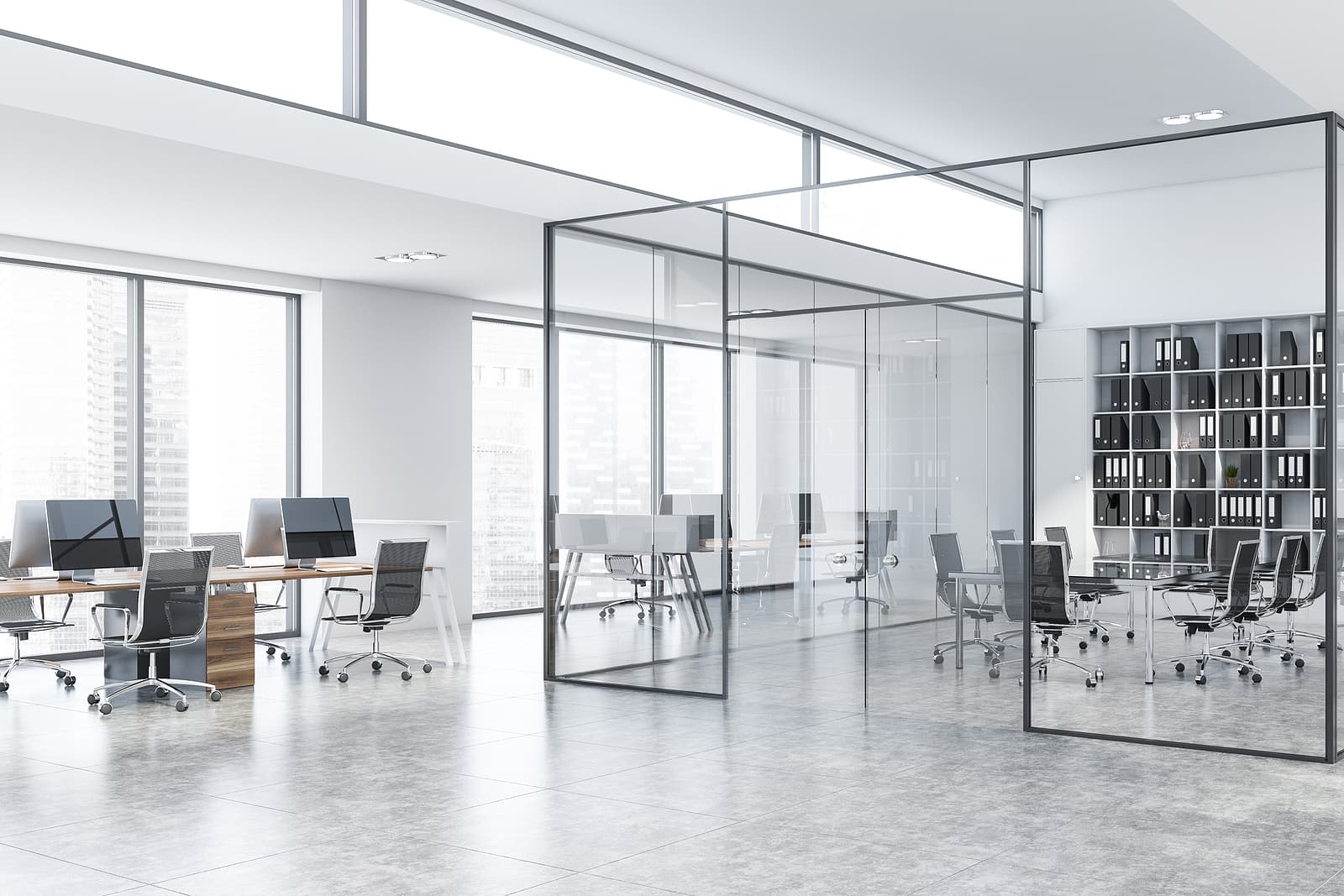
These materials are concrete, steel and structural glass, the three materials that make the grand, sweeping simplicity of the skyscraper possible, and enable large indoor spaces to have as much natural light as the outdoors themselves via clever partitioning.
The process of reaching this level is collaborative, with a lot of innovative design and architectural minds working over the course of decades to bring about a design philosophy that is familiar to modern business spaces.
However, whilst buildings such as the House of Glass and Oriel Chambers presented ways in which glass could be structurally significant and a central part of building design, there was arguably one art school more than any other that made glass central to modern architecture.
Art, Architecture And Production
Despite only existing for 14 years, there is arguably no art school as foundational to the world we live in today as Bauhaus, the “house of building” that sought to unify the various construction crafts and art under one roof made of concrete, glass and steel.
This concept, known even today as Gesamtkunstwerk or “total artwork”, is the idea that every skill, craft and art form that made up the construction of a building would be brought together to form a coherent whole, one ripe for radical experiments to determine the true nature of this unified art.
Much of the design principles for Bauhaus would therefore be inspired by other modernist movements from around the time, particularly the abstract and exceptionally minimalist Russian Constructivism movement of the 1910s.
Fuelled by a belief that form and function are inherently interconnected, Bauhaus went further, arguing that any architecture that is going to be valuable aesthetically also would need to be valuable functionally.
To that end, founder Walter Gropius had a singular focus on the aesthetic potential of mass production, and this unification of art, function and materials that would be readily used and readily available to the masses led to what is referred to as the International style.
Whilst the term was not widely used until 1932, the International style has become so interlinked with the principles of Bauhaus that some architectural critics incorrectly use the terms interchangeably. Officially, Bauhaus has no unified style but instead a set of unified principles.
With that said, the focus on mass production, exposed construction materials and function as form meant that there were some unifying elements, and glass was central both functionally and aesthetically to much of the Bauhaus philosophy.
Glass was exceptionally useful not only in providing a beautiful marriage of internal and external spaces but also as part of the principle of transparent design, where all of the aesthetic aspects of a particular design are clear for all to see.
This could be perhaps best seen at its Dessau site which the school moved to in 1926, characterised by its huge curtain wall of glass and steel designed by Mr Gropius as a monument to these principles, one that would later become synonymous with modern architecture itself.
However, changing the world does not always come easily, and the reasons why Bauhaus moved three times and had three separate faculty heads in just 14 years highlight this so critically.
Change And Conflict
The school was originally founded in Weimar in 1919 precisely because of a conflict between applied arts (such as architecture and design) and fine arts, with Walter Gropius becoming the director of an integrated school.
The aim was not initially to create the minimalist, purely functional style that would ultimately emerge, but instead create a new art and architectural style fit for the world of mass production.
However, whilst originally receiving state funding from the Thuringian government, these aesthetic tensions quickly boiled over into political tensions, with Bauhaus seen as destructive to the more traditional, conservative design principles found in the former German Empire.
These tensions led to the creation of the Haus am Horn, the first Bauhaus-designed building before their architectural department was even formed, albeit one that did not adopt the later focus on glass design that would become more associated with the school.
This eventually forced the entire school to move to Dessau, complete with a new, radically designed school building characterised by glass and steel.
Mr Gropius would resign in 1928, and his replacement Hannes Meyer would bring in a significantly different philosophical approach to Bauhaus inspired by his radical functionalism.
This approach, known as “Die neue Baulehre” (The new building method) eschewed aesthetics entirely, believing strongly that the core approach to construction should be based purely on fulfilling the daily needs of people using the building, as well as bringing students closer to the industry.
This approach was not well received, particularly when Mr Meyer forced many long-time instructors to resign, and was later accused of politicising the school and allowing radical political ideology to grow alongside radical architectural philosophies, which led to his firing in 1930.
He was replaced by the esteemed pioneer of modernist architecture Ludwig Mies van der Rohe, someone who already had experimented heavily with the uncompromising use of structural glass in his designs, alongside steel, brick and concrete elements.
As their director of architecture and final overall director, he attempted to return the focus of the school to the intermingling of functionalism and aesthetics, being exceptionally demanding but highly praised as a teacher of the aesthetic arts.
By this point, however, Bauhaus was the target of increasingly hostile attacks by a political system that saw its approach not as the future but as the destruction of the past.
Political manoeuvring forced the school to move to Berlin in 1932 but by 1933’s elections the school was accused by the government of being “cosmopolitan modernism”, a front for communism and an attack on German identity.
This forced the school to close and many of its students and designers to flee Germany entirely. This is ultimately what caused the spread of the International style, and arguably made the use of structural glass in architecture even more widespread than it would have been.